10 Facts About Orcas (Killer Whales)
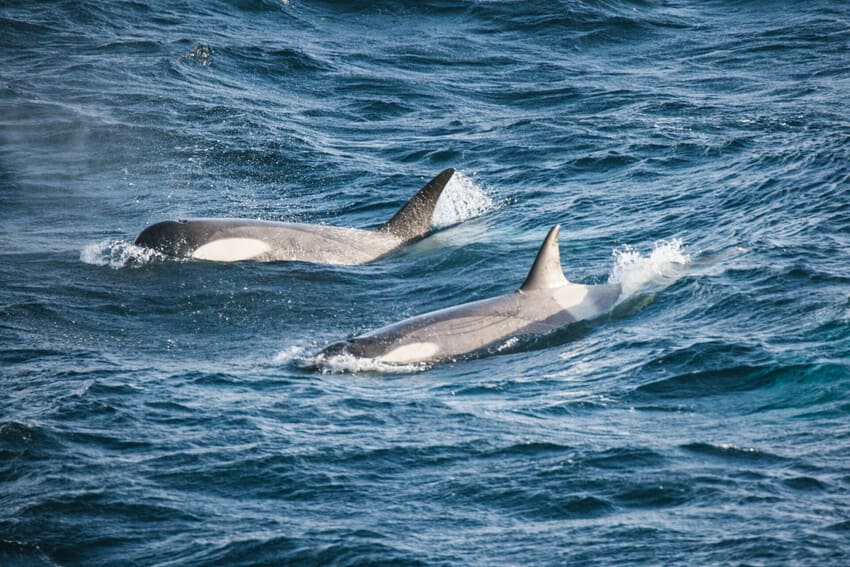
New to whale watching? Orcas are one of the easiest species to recognize in the wild thanks to their striking black-and-white coloring, large dorsal fin, and distinctive white patches behind the eyes. Despite their name, killer whales are actually the world’s largest oceanic dolphin species. They live in close-knit pods, are highly intelligent and social, and communicate through a complex system of calls unique to each group. As an apex predator, the orca sits at the very top of the marine food chain and can travel thousands of miles in search of prey. Whether you’re hoping to spot one on your first expedition cruise or simply want to learn more about these remarkable marine mammals, check out our 10 most fascinating facts about killer whales and discover where to encounter them in the wild.
Quick facts:
- Scientific name: Orcinus orca
- Animal group: marine mammals
- Other names: killer whale
- Size: Adult male orcas reach a length of around 8.2 meters (27 feet) and weigh up to 6,000 kilograms (13,300 pounds), female orcas reach lengths of around 7 meters (23 feet) and weigh up to 3,600 kilograms (8,000 pounds)
- Appearance: Black with white undersides, white patches near the eyes, large paddle-shaped flippers
- Dorsal fins: Up to 2 meters long and triangular (male orca), smaller and curved (female orca)
- Locations: Worldwide
- Conservation status: Protected species (note: the southern resident killer whale population, found in the coastal waters of southern Alaska, British Columbia, Washington state and California is listed as endangered)
Fact 1: Orcas Are Very Social
Orcas are highly complex and intelligent animals, and usually live in pods of five to 30 individuals. They have very strong family traditions, which include greetings, mourning, celebrations, and even unique dialects. Pods are matriarchal and led by the oldest female, whose knowledge helps guide the group to feeding grounds and through changing ocean conditions. Offspring stay with their mothers for life, although adult males leave temporarily to mate with females from other pods. Raising the young is a team effort. Once a female orca gives birth, the entire pod helps protect the calf and teach the next generation. Hunting techniques, communication, and social behaviors are all passed down through the family.
Did you know that male orcas are real mommy’s boys? Scientists studying southern resident killer whales have observed that older females often continue caring for their adult sons instead of producing more calves. They frequently share food with their grown sons and may even help reduce conflicts with other orcas. Although not all orca families are organized in the same way.
An orca’s ecotype strongly influences its lifestyle. Different ecotypes with distinct diets, behaviors, and cultures also feature different social structures. Resident orcas typically feed on fish and live in large, stable, highly vocal family groups. Transient orcas hunt for marine mammals such as seals and sea lions, travel in smaller groups, and remain quieter while hunting so they don’t alert their prey.
The northern resident population, inhabiting the coastal waters of British Columbia and southeastern Alaska, is organized into three acoustic clans: A, G, and R. This population consists of 34 pods and more than 200 individuals, organized into multiple matrilines sharing distinctive dialects.
And orcas aren’t the only members of the dolphin family with close-knit societies. Pilot whales, belonging to the oceanic dolphin family, live in stable matrilineal groups that cooperate and support one another throughout their lives.
On our Arctic expeditions, you may have the chance to observe orcas in the wild and get a glimpse of their social behavior as they travel, interact, and hunt together in the ocean. Explore our upcoming cruises
Fact 2: There Are 10 Ecotypes of Orcas Worldwide
While differences in appearance may be subtle, each ecotype has its own distinctive features. Due to different feeding habits that have evolved over millions of years, several ecotypes of orcas emerged, featuring genetic differences linked to food preferences and availability. The 10 recognized ecotypes include five Antarctic forms, two North Atlantic forms, and three North Pacific forms. The five Antarctic ecotypes differ mainly in their preferred prey, with some feeding on seals, while others prefer fish, penguins, or minke whales. The two North Atlantic ecotypes, found around Iceland, Scotland, and Norway, mostly feed on fish, other whales, and some types of marine mammals.
The three North Pacific ecotypes include resident, Bigg’s killer whales (also called transient whales), and offshore orcas. Transient whales mainly feed on marine mammals. In comparison, southern resident killer whales live in larger family groups and primarily feed on fish. Offshore orcas, which live in large pods of up to 50 individuals, often have worn-down teeth (as their diet includes sharks) and are known for their tough skin.
Fact 3: Their Name “Killer Whale” Originated in the 18th Century
In the 18th century, Spanish sailors spotted a group of orcas hunting other whales and large marine animals. Trying to find a suitable name for these giants, they came up with ballena asesina (whale killer in Spanish). Their Latin name, Orcinus orca, derives from Orcus (the Roman god of the underworld who is associated with death) and Orca (used to describe a large type of marine mammal). While the ferocious hunting techniques of these apex predators may have prompted such rather morbid names, orcas are known as some of the most intelligent and socially complex creatures in the world. While any whale encounter calls for caution, orcas tend to not be aggressive toward humans. Have you ever spotted an orca in real life? Based on your encounter, what would you name them?
Fact 4: Orcas Are the Largest Dolphin Species
The world’s largest dolphin is actually an orca! Although their size and famous nickname (“killer whale”) make people think of them as whales, orcas are members of the dolphin family. Dolphins are a type of whale, meaning every dolphin is a whale, but not every whale is a dolphin. Orcas belong to the toothed whales and are the largest species within the oceanic dolphin family.
Unlike their smaller dolphin cousins that feed mainly on fish and squid, orcas are among the most powerful predators in the ocean. Their diet varies depending on their ecotype and the area where they live. While some populations hunt fish, others target marine mammals. Their intelligence, teamwork, and sophisticated hunting strategies allow them to occupy the very top of the marine food chain.
Part of the Dolphin Family
Around 30 species of highly social marine mammals belong to the dolphin family (Delphinidae), and orcas are one of them. Like other dolphins, orcas rely on echolocation to navigate and hunt, producing clicking sounds and detecting the returning echoes. They also communicate through whistles, calls, and pulsed sounds. What makes orcas so special is their advanced social behavior. Their close-knit family groups cooperate while hunting and pass different traditions, dialects, and unique hunting techniques from generation to generation.
Not All Whales Are Dolphins
Orcas are toothed whales (Odontoceti) and use echolocation to hunt prey. This group includes dolphins, porpoises, sperm whales, and beaked whales. Orcas are among the largest and most specialized members of this group, but their hunting abilities make them different from most other dolphins. They are able to cooperate in highly coordinated ways and can take down prey much larger than themselves. Their relationship with other dolphin species is complex, ranging from playful interactions to preying on smaller dolphins.
On the other hand, baleen whales (Mysticeti) do not have teeth. They use baleen plates to filter krill and plankton from the water. Species such as humpback whales, blue whales, and fin whales belong to this group.
Fact 5: They Hunt Using Echolocation
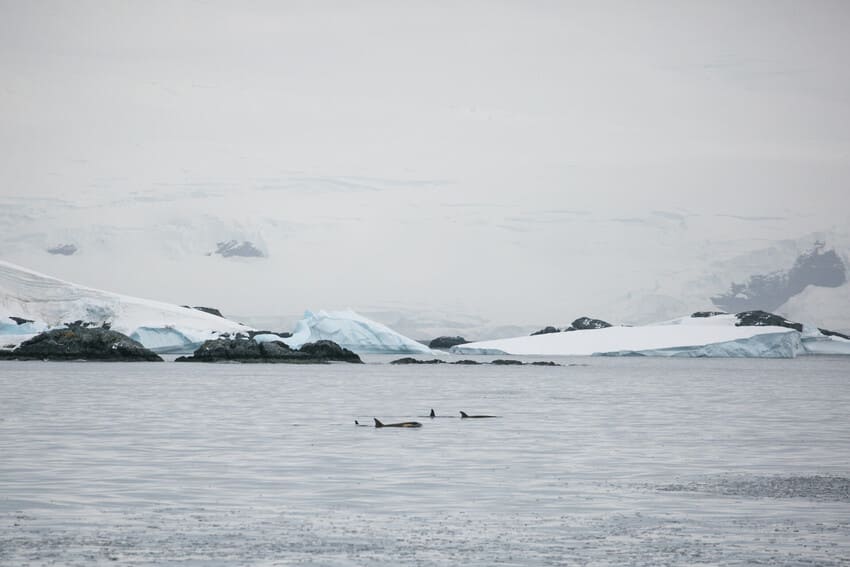
Killer whales are masters of echolocation. They can detect prey underwater from distances of up to 150 meters (500 feet) using a series of rapid clicks. These underwater sounds travel through the ocean and bounce back as echoes when they encounter an object. By interpreting these returning echoes, orcas can determine the size, shape, density, and movement of potential prey, even in dark, deep, or murky waters. Like all toothed whales, orcas have specialized adaptations for echolocation. Sounds are produced inside their nasal passages, which are located beneath the blowhole. These sounds are then focused through the melon, the rounded structure of fatty tissue in the forehead, which acts like an acoustic lens, directing sound waves into the water. When echoes return, they are received through the lower jaw and transmitted to the inner ear and brain, where orcas build a detailed picture of their surroundings.
Orcas produce different types of sounds depending on the situation. Calls, whistles, and clicks occur at lower frequencies, ranging from around 0.5 to 25 kHz, while echolocation clicks typically occur at much higher frequencies, from around 45 to 80 kHz. Not all orcas use echolocation in exactly the same way, and hunting strategies depend on their ecotype and preferred prey. Fish-eating resident orcas focus on active echolocation, as prey such as salmon are less sensitive to these high-frequency sounds. Mammal-hunting Bigg’s (transient) orcas rely on passive listening when approaching seals and other marine mammals, which can detect sounds more easily. For these species, silence helps avoid alerting their prey before they launch an attack.
Did you know that underwater noise from ships can interfere with an orca’s ability to communicate, navigate, and hunt? Speed restrictions for vessels, the use of quieter ship engines, and the establishment of protected areas are some of the measures that help protect these incredible animals.
Fact 6: Orcas Are Apex Predators That Shape the Ocean’s Ecosystems
Orcas are fierce apex predators and sit at the very top of the food web with no natural predators. Killer whales play an important role in maintaining a balance throughout marine ecosystems, and their influence goes far beyond the animals they hunt. By controlling prey populations, the ripple effect travels through the ocean environment, which is known as trophic cascade. In parts of western Alaska, scientists linked increased killer whale predation on sea otters to declining otter populations. With fewer sea otters to regulate sea urchins, urchin numbers increased and kelp forests declined. This demonstrates how powerful changes at the top of the food web ripple through the entire ecosystem.
Even larger prey aren’t out of reach for orcas, as some populations have been known to hunt other whales, including sperm and humpback whale calves. For these ambitious hunting endeavors, perfectly coordinated strategies are vital for success. While adult humpback whales will defend their calves aggressively, orcas try to separate, surround, and exhaust their prey. Humpback whales are also known to approach ongoing orca hunts to interfere, creating a fascinating evolutionary battle between predators and prey.
Different orca ecotypes occupy different ecological niches. Northern resident orcas specialize in hunting fish, especially salmon, while Bigg’s (transient) orcas hunt marine mammals. Controlling different prey populations in different regions, orcas help shape the health and structure of the ocean ecosystems. Their intelligence, adaptability, and diverse hunting strategies make them some of the most important predators in the marine world.
Fact 7: Orcas Are Chatty Fellows
They do not only rely on underwater sounds to locate their prey but also communicate with other members of the pod via clicks, pulsed calls, and whistles. Orcas use their nasal sacs within their blowholes to communicate (since they lack vocal cords) and create sounds by moving air through them. Did you know that Orcas have distinct languages? Killer whales belonging to different ecotypes have their very own accents, connected to their specific feeding behavior. While offshore killer whales (which prefer marine mammals as food) hunt in silence, resident killer whales (feeding on fish) emit clicks while chasing their prey, as fish can’t pick up their frequency. Additionally, each pod has its own unique dialect, which young orcas learn from older family members. And communication includes long-distance calls! Orcas can talk with their pod from around 12 kilometers (over 7 miles) away.
Fact 8: Orcas Sleep With One Eye Open
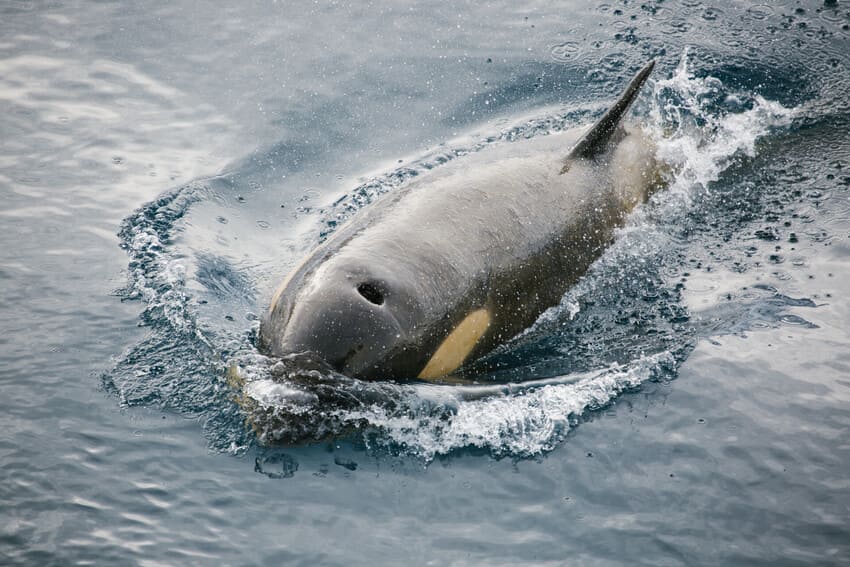
Orcas can shut down half of their brain hemisphere, and they do so when they sleep! As killer whales are voluntary breathers, they need to keep their brain partially active to keep breathing, even during rest time. While sleeping, the eye connected to the awake side of the brain remains open. This ingenious skill is called unihemispheric sleep and also lets orcas regulate their body temperature and stay aware of their surroundings while napping. And they aren’t the only ones who master this unique skill. Walruses, whales, other dolphins, steller sea lions, crocodiles, and chickens practice unihemispheric sleep.
Fact 9: You Can Find Them All Over the World’s Oceans
While killer whales prefer colder waters, they roam the Earth’s oceans and can even be spotted in locations like the Caribbean Islands! In comparison to other whales, orcas’ migration patterns depend on where their preferred prey is abundant. Depending on the specific ecotype of Orcinus orca, this can be Antarctica, the Arctic or subtropical and tropical waters. Southern resident killer whales, for example, adjust their seasonal migration to follow salmon, which is their main prey. While Chinook salmon used to be abundant in the Salish Sea during the spawning season in summer, recent years have shown a decrease in fish, pushing southern residents to adjust their migration routes accordingly.
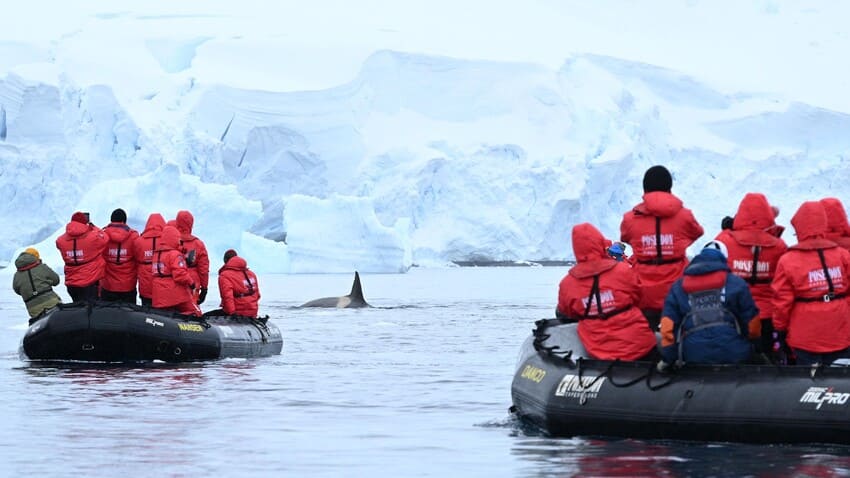
If you want to get the chance to encounter these majestic apex predators in their natural habitat, board one of our iconic cruises to the Arctic (Greenland and Iceland) or Antarctica. Our Greenland voyages provide opportunities to observe orcas alongside other marine mammals, explore fjords, and navigate remote Arctic waterways. The large open deck aboard our expedition ship, M/V Sea Spirit, is perfect for whale watching!
Fact 10: Southern Resident Killer Whales Are Critically Endangered
While collectively around 50,000 orcas roam the planet’s oceans, the southern resident ecotype found in the Pacific Northwest faces extinction. As of 2025, there are only 73 animals left across three family pods, and conservation efforts focus on determining threats to their existence, as well as how to mitigate them. Listed as an endangered species under both U.S. and Canadian conservation laws, southern residents are the focus of extensive recovery efforts aimed at protecting their habitat, restoring their food supply, and reducing human-caused threats.
Unlike other orca populations, southern residents have a highly specialized diet consisting almost entirely of salmon, especially Chinook salmon. These are large, energy-rich fish that are essential for the whales’ survival. With Chinook salmon populations in decline throughout the Pacific Northwest due to habitat loss, dams, overfishing, and changes in ocean conditions, southern residents spend more time searching for food, leading to nutritional stress and fewer successful pregnancies. In the Yukon River, Chinook salmon run sizes have declined by around 90% between 1981 and 2023.
Southern vs. Northern Residents
While they share many similarities, including a fish-based diet and complex family structures, their conservation status tells two different stories. Northern resident killer whales, found in coastal waters of British Columbia and southeastern Alaska, have a much larger population and are not considered endangered. Southern residents, in contrast, have experienced decades of population decline, and their smaller population size makes them especially vulnerable to environmental changes. Every individual in the population plays an important role in the survival of the pod. Conservation efforts focus on protecting their habitat, improving Chinook salmon populations, reducing underwater noise, and managing vessel activity in important feeding areas. Human activity has a significant impact, with noise from boats interfering with echolocation and communication. Vessel traffic can force whales to change their behavior and spend valuable energy avoiding such disturbances. Pollution and contaminants can accumulate in their bodies and affect immune systems and reproduction.
FAQ
What do orcas eat?
Orcas’ diets depend on their ecotype and prey availability. Resident orcas mainly feed on fish, especially energy-rich Chinook salmon. Bigg’s (transient) orcas specialize in hunting marine mammals, including seals, sea lions, porpoises, and even other whales. Offshore orcas have a different diet, often feeding on sharks and developing worn teeth from feeding on their tough skins. These specific diets have created distinct cultural groups with unique hunting behaviors.
Are orcas whales?
Yes, orcas are whales, the largest members of the oceanic dolphin family (Delphinidae), and belong to the toothed whale group (Odontoceti). The name “killer whale” can be confusing, but all dolphins are whales, while not all whales are dolphins. Orcas are both whales and dolphins, and are the largest dolphin species on Earth.
How fast are orcas?
Orcas reach speeds of up to 56 km/h (35 mph) during short bursts, helping them catch fast-moving prey such as dolphins and porpoises. Their typical cruising speed is around 8-13 km/h (5-8 mph). Combined with impressive endurance, these speeds allow them to travel long distances of up to 160 km (100 miles) per day.
What are baby orcas called?
Baby orcas are called calves. After a gestation period of around 17 months, a female gives birth to a single calf, which is nursed for one to two years. Offspring depend on their mothers and the pod for protection and learning. In resident populations, they often stay with their mother for their entire lives. First-born calves usually have lower survival rates, while experienced mothers tend to have more successful offspring.
How smart are orcas?
Orcas are among the most intelligent marine mammals, with complex social structures, lifelong family bonds, and matriarchal societies. Each pod develops its own unique traditions and dialects, which are passed from generation to generation. Older orcas teach younger members how to hunt and pass on their pod’s unique culture. Their large brains, advanced communication abilities, problem-solving skills, and cooperative hunting tactics make them exceptional ocean predators.
Related Cruises
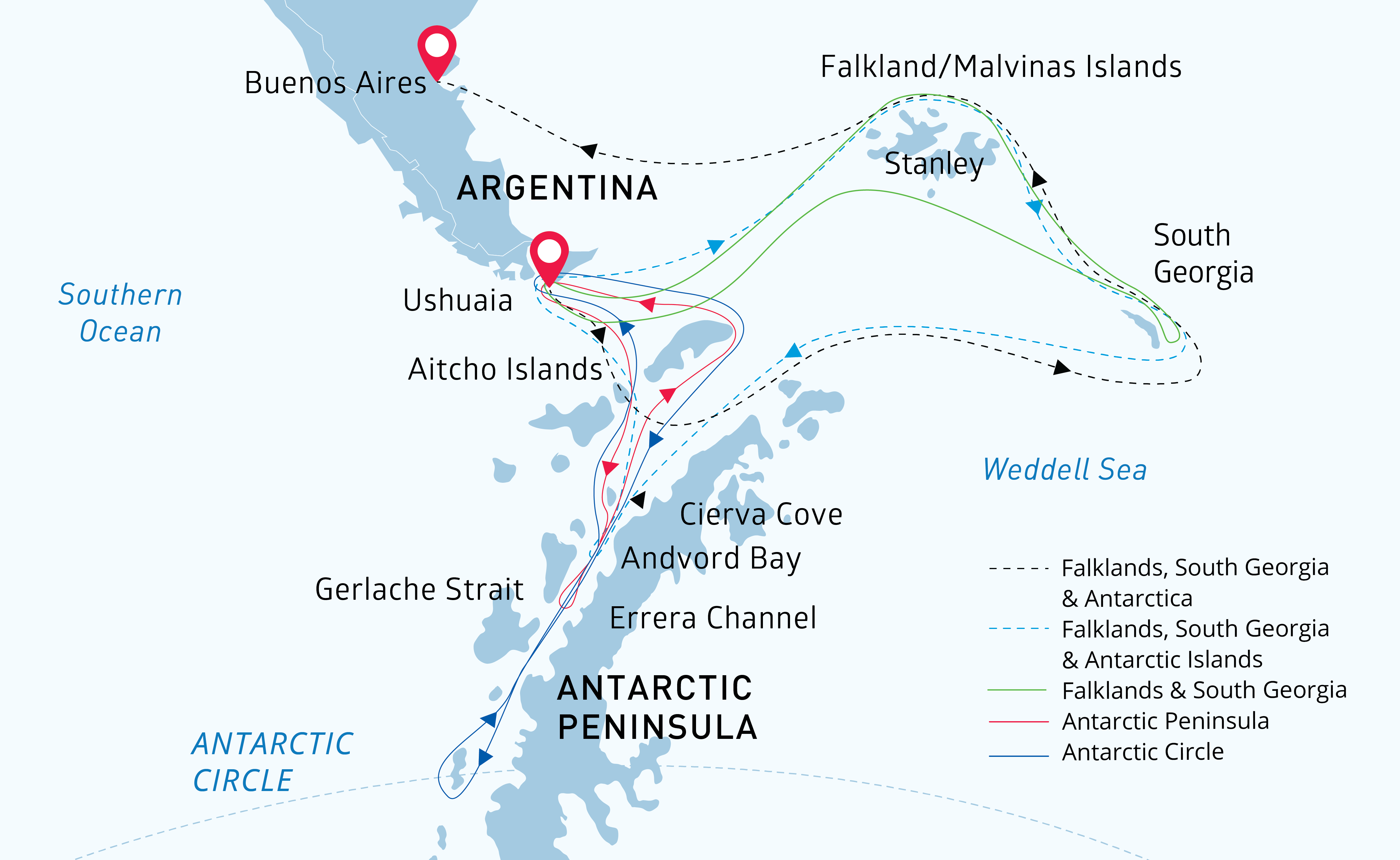

Antarctica


.png)
South Georgia & Falklands
Antarctic Peninsula