The People of the Faroe Islands
Picture-perfect shots of pristine nature, quaint villages and the promise of an adventure off the beaten path – there are countless posts on social media of prime locations around the world trying to lure the intrepid traveler to come visit. But while many destinations use the label “off the beaten path” merely as a clever marketing tool, the Faroe Islands are one of the few places that’s truly earned such bragging rights! The archipelago (also called Føroyar Islands or Færøerne Islands) welcomes only around 100,000 visitors per year and is a gem for anyone who wants to discover unique traditions, culture, incredible landscapes and rare seabirds. Read on and find out why the Faroe Islands should be on top of your travel bucket list!
Geography and Natural Environment
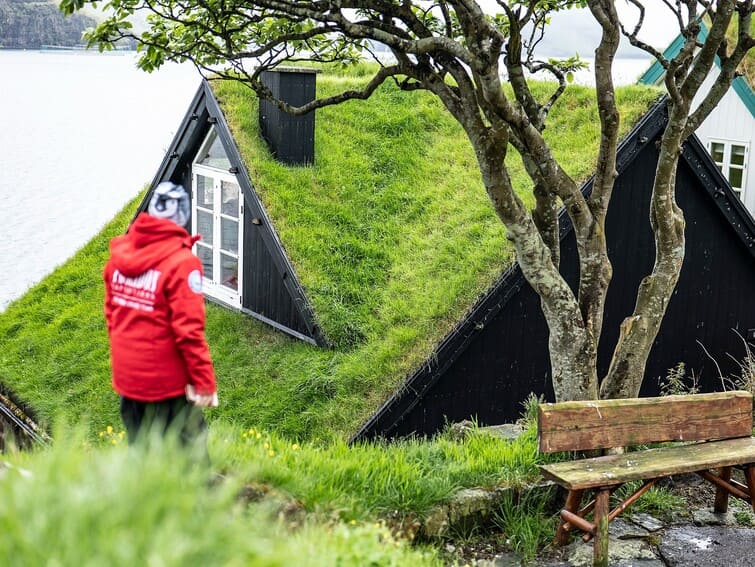
It’s a place right out of a fairy tale! The naturally treeless archipelago consists of volcanic rocks, covered by peat soil. The green hilly landscapes of the islands slope toward steep cliffs facing the ocean. Weather changes fast, from sunshine to rain within moments. Expect fog, especially around June and July. The Faroese have 37 words to describe different types of fog, such as very thick fog (mjørkakógv), bank of fog (flóki) and low-lying sea mist (pollamjørki). Due to the harsh maritime subarctic climate and the prevailing peat soil, there are no endemic tree species on the islands, and the natural vegetation is mostly grass, moss and wildflowers. Artificial attempts to plant trees on the island started in 1904 outside Tórshavn, and have since been expanded to other areas on the archipelago.
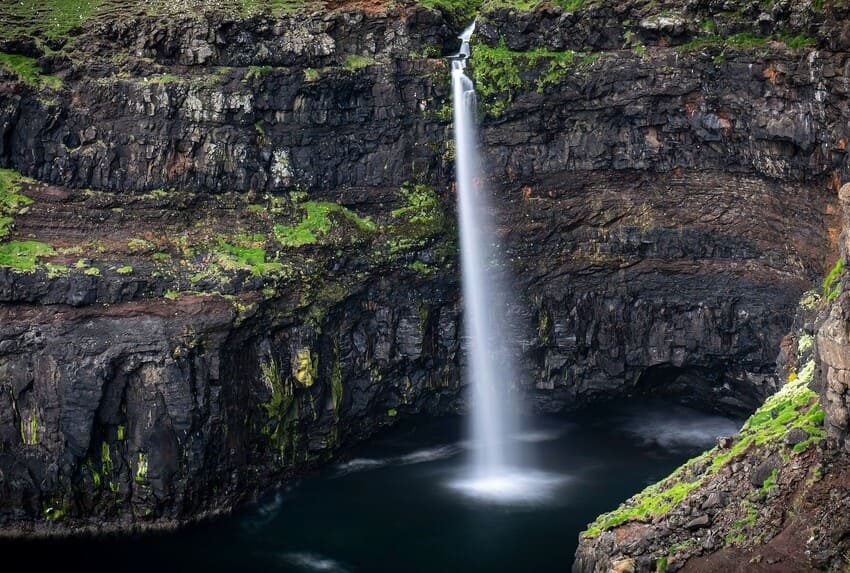
You can find around 20 tunnels on the archipelago, four of them connecting parts of the islands under the ocean. Several other tunnels cut through the mountainous terrain, connecting secluded villages to the main road network. Fun fact: Up until 2004, the remote village Gásadalur, featuring the famous Múlafossur Waterfall, was only reachable via a steep mountain path. Since 2004, a 1.4-kilometer (0.9 mile) tunnel has made Gásadalur accessible by road. Prior to that, the local postman had to hike the steep trail three times a week to deliver mail to the 16 residents of the village!
History and Settlement
- 300 AD: Unknown people live on the islands
- Around 600 AD: Irish monks settle on the islands
- Ca. 800 AD: Norwegian farmers arrive
- Ca. 900 AD: The Faroese Parliament is founded (first named Althing, later Løgting), making it the second-oldest parliament in the world after the Icelandic Althing
- Ca. 1000 AD: Christianity is adopted
- 1540: King Christian III of Denmark introduces Lutheranism
- 1816: The Løgting is abolished and replaced by the Danish judiciary
- 1846: Venceslaus Ulricus Hammershaimb creates the Faroese written language
- 1849: Denmark receives a democratic constitution and two Faroese representatives are given seats in the Danish Parliament
- 1906: The first political parties are founded, the Sambandsflokkurin (Union Party) and the Sjálvstýrisflokkurin (Liberal Party)
- 1919: Faroese students create the first Faroese flag in Copenhagen
- 1938: The Faroese and Danish languages receive equal status in schools and churches
- 1940: British Forces occupy the islands in Operation Valentine during the Second World War (after British Forces leave in 1945, the Faroese flag is officially recognized by the British government)
- 1948: The Home Rule Act passes, granting self-governing status within the Kingdom of Denmark
- 1952: The Løgting is re-designated county council with an advisory role
- 2005: The Home Rule Act is extended (known as the Takeover Act), expanding the powers of the Faroese Parliament
Fun fact: Did you know that the Faroese Islands could have become British in 1524? King Christian II of Norway offered the islands to Henry VIII of England as collateral for a loan after going into exile. Henry declined. According to historians, this decision saved the Faroes from losing their unique language, as happened in the Shetland and Orkney Islands.
Population and Demographics
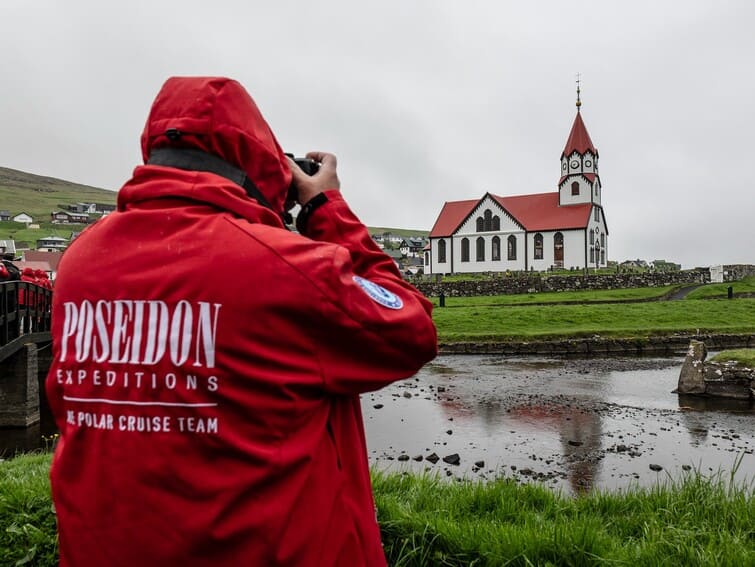
There are more sheep than people on the Faroe Islands. An estimated 70,000 wooly grazers inhabit the area, but the total population of the North Atlantic archipelago as of 2025 is only around 55,769. While around 14,000 people live in Tórshavn, the small village of Sund, located just a 14-minute car ride north of the capital, features only one inhabitant! Today’s Faroese people descend from Norse, Gaelic, Scandinavian and British Isles ancestry. There is no such thing as Faroese citizenship; islanders hold Danish citizenship.
Interesting fact: Over the past 20 years, the Faroe Islands’ fertility rate was above Europe’s average, with around 2.5 children per woman of childbearing age. While it has continuously decreased since 2016, it still scores among the highest in Europe.
Language and Culture
The Faroe Islanders are a great example of a nation keeping its national identity and unique language, despite centuries of colonization. Descending from Old Norse, Faroese is closely related to Icelandic and the languages of other Nordic countries. The oldest Faroese text dates back to 1310 and, while mostly composed in Norse, it contains specific Faroese words found in later documents. From the early 16th century, the Danish language started to replace Faroese. In 1846, Faroese linguist Venceslaus Ulricus Hammershaimb recreated the modern written Faroese language, which borrows several Icelandic parts of the alphabet. The spoken language differs, however, and while Icelanders may be able to read Faroese, understanding it in speech is much trickier.
Economy and Industry
As the islands are located remotely in the Atlantic Ocean, fishing industries have been the most important drivers of the Faroese economy since the 1920s. Today, fishing and aquafarms contribute up to 10% and 16% of the GDP, respectively, and fish and seafood represent 90% of exported goods. The cold, clean and oxygen-rich waters in the fjords are the ideal place for Atlantic salmon farms. The Faroese companies Bakkafrost and Hiddenfjords, as well as the Norwegian company MOWI own the local aqua farms. While whale hunting is a historical tradition on the archipelago to this day, the export of whale products is restricted.
The island group grants fishing rights, and has free trade agreements with the EU and other countries. Given the Faroe Islands’ dependency on the fishing industry, efforts to foster other industries are in progress. While still a small part of the local economy, industries such as tourism, financial services, manufacturing, maritime services, IT and civil aviation are showing promise.
Government and Society
Although the Faroe Islands have been a self-governing nation since 1948, they remain a part of the Kingdom of Denmark. The Danish government has limited control and oversees areas such as foreign affairs, defense and justice, while the Faroese govern issues such as education, healthcare and fisheries. Although Denmark is part of the European Union, the Faroe Islands are not a part of it. The Faroese parliament (Løgting) consists of 33 members, which are elected for four years.
The Faroese People: Character and Hospitality
Faroe Islanders are a friendly bunch! Expect a warm welcome, learn about their culture and listen to their stories. Faroese people have a strong national identity and like to share their traditions with visitors. You can take part in a traditional dinner experience, just as if you’d be visiting old friends on the Faroes! Heimablídni is a tradition where visitors attend a meal in local people’s homes. While it’s a paid dinner, the experience is authentic and intimate. You’ll not only get a peek into peoples’ private homes, but also get to try the unique cuisine. And some of the local delicacies may be only for the adventurous foodies out there. Expect anything from whale meat, blubber and dried fermented sheep meat.
Tourism in the Faroe Islands
Whether you are a nature enthusiast, bird lover or a culture fanatic, this remote gem in the North Atlantic will not disappoint. We’ve gathered a few favorites for what to do when visiting the Faroe Islands:
Take a hike
With plenty of scenic trails around the islands, you’ll find the perfect route to enjoy the unique nature and landscapes, whether you are a lazy stroller or an avid hiker. If you’re up for a medium-level hike, try the 6-kilometer/3.7-mile (one way) trail from Tórshavn to Kirkjubøur. You’ll pass two lakes (spot Kittiwakes in summer), a rock dais which was used for folk meetings up until the 1960s, and get scenic views of the islands of Sandoy, Hestur, Vágoy and Koltur. You’ll conclude your hike in the quaint village of Kirkjubøur, featuring Kirkjubøur Church, the oldest church on the Faroe Islands (built in the 13th century).
Hit the road
Rent a car and explore at your own speed. There are four underwater tunnels linking the islands Streymoy, Sandoy, Vágar, Eysturoy and Bordoy, as well as various tunnels cutting through mountains, making small and quaint villages accessible by car. For those islands not connected via tunnel, you can use the ferries. Discover beautiful waterfalls (such as the picturesque Múlafossur Waterfall in Gásadalur), see Lake Sørvágsvatn (which appears to float above sea level) or visit a local sheep farm (such as Hanusarstova on Eysturoy Island).
Watch the birds
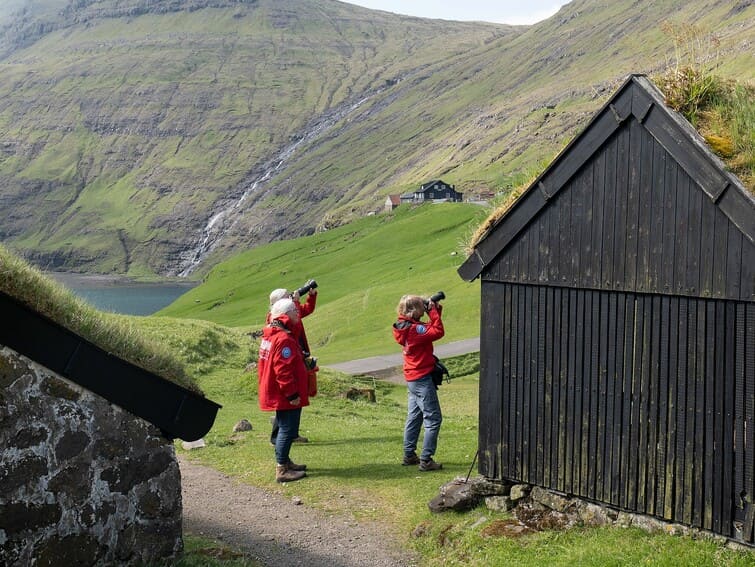
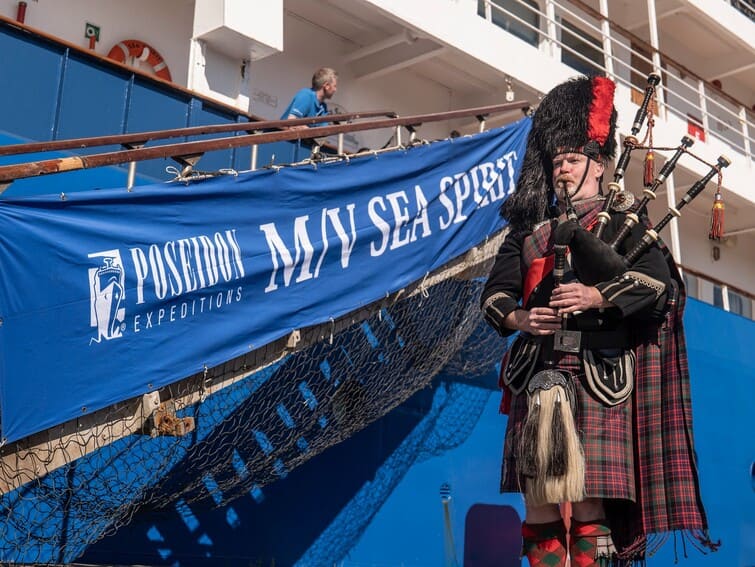
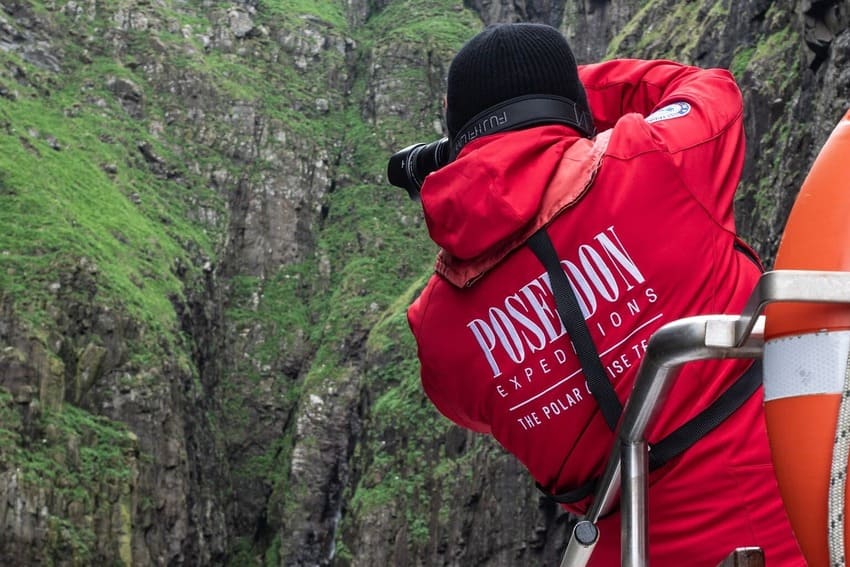
Iconic seabirds swarm the steep cliffs of the Faroes. Popular destinations for bird watching are Mykines island (accessible via ferry during the summer and famous for puffins), Cape Enniberg (via organized boat trips) and Lake Toftavatn in the south of Eysturoy Island (accessible via hiking trails, some starting near Runavík). If you’re visiting as part of an expedition cruise, you’ll get the best opportunities to bird watch! Enjoy stunning views from deck or aboard small, motorized Zodiac boats, taking you closer to the viewing sites. Join a Poseidon cruise to the Faroes.
Facts about the Faroe Islands
- Capital city: Tórshavn (located on the largest island, Streymoy)
- Total population: 55,769 (based on United Nations estimates, February 2025)
- Number of islands in the archipelago: 18 main islands (around 750 islands in total), connected by ferries and 4 sub-sea tunnels
- Total land area: 1,399 square kilometers (540 square miles)
- Location: North Atlantic Ocean, about halfway between Iceland and Scotland
- Official languages: Faroese (first) and Danish (second)
- Legal status: Self-governing nation within the Kingdom of Denmark
- Currency: Faroese krona, but Danish krone (as well as major credit cards) are equally accepted
- Head of government: Aksel V. Johannesen (Faroese prime minister since 2022), Social Democratic Party
- Climate and Weather: Subpolar oceanic climate, with cool summers and mild winters (the weather is very unpredictable, changing from sunny to rainy at a moment’s notice)
FAQs
What is the ethnicity of the Faroese people?
The Faroese people’s origins are Norse and Gaelic (through Gaelic monks who arrived in the sixth century and Norse culture that followed in the ninth).
Do they speak English in the Faroe Islands?
Most Faroese people speak fluent English. The national language is Faroese, a language descending from Old Norse. The Danish language is the second official language of the island group.
What is the nationality of the Faroe Islands?
Most Faroese Islanders are Danish citizens, though the Faroe Islands are a self-governing nation within the Kingdom of Denmark. Faroe Islanders are known for their strong Faroese national identity.
Why are the Faroe Islands so famous?
Some of the highlights of the islands are their incredible landscapes, rich history, remoteness and the traditional way of life of Faroese people. The grass-roofed turf houses are a local masterpiece and the islands’ steep cliffs feature a vibrant birdlife, which is a must-see for bird lovers.
Are Faroese people friendly?
Yes, Faroese Islanders are very friendly, outgoing and hospitable people. Tourists often regard them as very willing to talk calmly and politely, with a very low level of stress.